
30.6K
Downloads
173
Episodes
Episodes

Sunday Aug 31, 2025
Sunday Aug 31, 2025
Bookbinding
 I cased in two books in the last week. One, The Kenrokuen Souvenir Notebook, is an A6 (pocketbook-size) mostly blank notebook. The recto pages (right side) contain really short Japanese lessons; translations of useful (?) words you might need while being a non-Japanese tourist in Kanazawa. The verso pages (left side) are lined for your writing pleasure.
A video of the pages being printed and folded is available here. A video of Kenrokuen Souvenir Notebook being cased in will appear semi-shortly. I mean well within this year. I hope.
The cover has two outdents: a circle and a bar on the front to distinguish it from the back, which has no such design element.
The second book was, in my estimation, sloppily done. The textblock is crooked on the cover, the endpapers sits cattywampus on the textblock, and the cover was hastily thrown together. The cover itself was meant to convey Marcel Proust in Paris. But it doesn’t; it portrays a man straight out of One Hundred Years of Solitude in Paris.
The content, however, is the important part of this  book. It is 200 pages liberated from Marcel Proust’s The Guermantes Way. I cannot read Proust on my laptop or iPhone. I need to read a Real Book™. So I print out my Project Gutenberg download. I print them in editions of about 100-200 pages instead of all at once. Why? Easier to carry. I mark up the printed version with notes, dates of completion, circles, lines circling back to related passages, and hundreds of thousands of question marks.
Fiction
I continue to edit Molly Bright, write on Growing Slurry, and procrastinate on a hundred other writing projects. These procrastinate-linked projects include; three mystery/detective novels set in Kanazawa, one literary detective novel set in Seattle, one futuristic dystopian novel, and six English textbooks (three for specialized mechanical engineers, and salemen, one for medical students, and two for general university students).
A less-than four-minute flick (viewable here) about printing and folding an A6-size semi-blank notebook. It’s semi-blank because the left (verso) page has lines on it for writing notes of your trip. And the right (recto) page has words or phrases in Japanese and English, possibly useful. For example, at the bottom of page 3 is:
お金 — o-kane – money
Now, 金 alone can mean gold, money, iron, or metal depending on the context. 金 can be pronounced kin, kon, kane or kana, also depending on the context. For example, the 金 in 金沢 (Kanazawa) is pronounced kana and means gold. But with the お in front of it, it is pronounced okane and means money.
As an aside, 金髪 is pronounced kinpatsu and means blonde hair. 髪 is pronounced kami and hatsu and means hair.
But you’re not going to get this level of Japanese language education in either the four-minute video or the actual Real Book™ because this blog doesn’t teach Japanese, except as it applies to either bookbinding or fiction. Or, obviously, a video.
Friday Aug 15, 2025
Friday Aug 15, 2025
Bookbinding
 About two months ago, probably longer, I folded two sets of A5 sheets of paper in order to make two A6 notebooks (blank). Those signatures sat on my workbench for those months, unfinished. I took a short trip to another part of Japan, visited friends, recharged my passion for living, and came back to Kanazawa (in a heavy rainstorm. I actually left Kanazawa in a heavy rainstorm, too.)
After a couple of days relaxing from my not-necessarily relaxing vacation, I started to work on those two books and finished them today.
 The first one is a gift for a co-worker. It’s A6 with seven signatures of four folios each. It has my co-worker’s name on the front and her family name on the spine. It has page numbers and a ninja in various situations (left and right bottom and top corners.) Plus, a couple of shots of a local famous garden (Kenrokuen, if you’re interested). Plus, a very small, black and white, artsy photo of me that you can barely tell who it is.
The second blank notebook is similar: seven signatures of four folios each, but no page numbers or other decorations save for a photo of a local river (the Saigawa, if you’re interested). This one is called The Saigawa Committee Notebook for no apparent reason. Another future notebook will be called The Spanish Exploration Committee of the Saigawa Notebook.
 On both of these, I practiced printing the title on the spine as my two other unfinished projects require it. Yes, after these two books sat on my workbench for a couple of months, I have two more unfinished projects.
Read on.
Fiction
Speaking of not finished, incomplete, and shockingly surprised, I thought I had two novels that would be of  interest to two people. The first friend is reading Moby Dick, and I wrote a novel called Growing Slurry, which has a heavy Moby Dick influence. Both main characters are re-reading the Melville novel; several chapters of Growing Slurry copy the style of different Moby Dick chapters, and one character is searching for a mysterious person (not a whale). I thought I would print, bind Growing Slurry, and give my friend the book.
To my surprise, I hadn’t finished writing Growing Slurry! I thought I had. In my brain, I’m sure I had. So now I’m writing it in order to give it to the friend who is reading Moby Dick.
My other friend lives where my novel Molly Bright begins (Miyazaki, if you’re interested), and I wanted him to read it and critique it so I can improve it. I opened it on my computer, read through it – scanned and skimmed it, really – and discovered — to my horror! — that I hadn’t finished it either! My oh my.
 Now I have to finish two novels that I thought I already finished. Besides the two I know I have finished, but want to (Caraculiambro and Merengue, if you’re interested).
Video
And, yes, I have film footage of a couple of books that I have bound that I have not yet made into a YouTube video for your viewing pleasure. Incomplete, again! Goodness, am I that lazy? Or that busy?
Friday Jul 18, 2025
Friday Jul 18, 2025
Bookbinding


This week in bookbinding, I made an A6-size blank notebook with a relatively unique cover. First, the book is six signatures with four folios each. It’s called The Complete Saigawa Exploration Committee Notebook. In both Japanese (犀川探検委員会全集) and, of course, English for you non-Japanese speakers/readers. The Saigawa is one of two big rivers that flow through Kanazawa (the other being the Asano river, meaning shallow river.)
 But the point of this book is the cover. First, it has a flap that goes over the front edge, but it’s not tied down. It covers about 2/3rds of the back cover, keeping the pages protected. Second, it is mostly green, as is the thread. On the front cover are two decorative bits. First, a wide vertical band of colorful red-blue-black-white Japanese-style chiyogami. But on top of the chiyogami is a wider, thin, green, lacy paper that is only glued down on the inside; the part that covers the front flaps freely. The endpapers on the back are greenish-red-yellow chiyogami with birds. The endpapers on the front are the same colorful chiyogami as on the front cover and the same bird chiyogami.
Fiction
I have just started writing again after the trauma of two+ months ago. However, I am looking at two unfinished novels. One is The Merengue Dancer and the other is Caraculiambro.
I started The Merengue Dancer maybe three or four years ago. Merengue is a character from my novel Molly Bright. In that novel, he plays a free-spirited Japanese man who was a former company employee. He helps Molly and other vagabonds find a kidnapped physicist when the Japanese police aren’t interested. In Merengue, we learn how he came to be a free-spirited person.
I started Caraculiambro maybe ten years ago. Maybe more. The name comes from Cervantes’ Don Quixote. He is a giant Don Quixote is going to fight, defeat, and give to his lady friend, Dulcinea del Toboso. Like Dulcinea, Caraculiambro is a figment of Don Quixote’s imagination; he never appears in the novel. He’s only talked about. In Caraculiambro, he is a giant, driven out of his hometown (Olympia), and he becomes a private detective in the town of S—, which he does not wish to identify (straight from Don Quixote, the novel.). The first character he comes across in the opening scene is a character very much like Don Quixote. He investigates a murder, a case of fraud, a conspiracy involving real estate, and the death of a character very much like Don Quixote.
The Complete Saigawa Exploration Committee Notebook can be seen being folded and sewn (mostly) here. It is the longest video I have sprung on you, my listeners, at almost 14 minutes. I do a lot of talking and bookbinding on it, but it’s not packed with information. Please enjoy.
Monday Jul 07, 2025
Monday Jul 07, 2025
Bookbinding

 This is the first book I’ve bound in a couple of three-four months; maybe more. It’s A5, five signatures of five folios each. It is unique in that it has two endpapers on the front and back. The second endpaper is not glued to the cover but it looks nice.
 When I first made this book (I made it twice), the thread got caught on the cover but I didn’t notice it until I was finished. I wondered why the stitching on the cover was loose until I opened the book and found a large thread relaxing between pages.
I untied the whole book and started over. Even adjusted a few sewing holes that I didn’t like the first time. You can see these on the photos.
Fiction
I’ve written a short story of about 13 pages titled Raul’s Paris Disneyland Farewell Party. Raul and Marcella work for the same company but in different offices (Raul is in Spain, Marcella in Morocco) but the company is going belly-up. Raul wants a farewell party. He invites Marcella and an unnamed narrator who flies in from Tokyo. While enjoying a whiskey in a small, well-lit café in Madrid, Raul meets Odette in an unusual way. The four of them meet in Paris, get a hotel in Guermantes Village because it’s near Disneyland, and proceed to get drunk.
It is influenced by Proust’s Swann’s Way and Guermantes Way, which I didn’t know was near Disneyland so I incorporated the mouse into the short story.
Video
For your view pleasure I have two short (less than two minutes) videos up on YouTube about me cutting files to use as book boards. I have lots of files. Many, many, many files. Both my wife and were teachers and collected a huge amount of files during our years together. The videos can be found here and here.
Sunday Jun 01, 2025
Sunday Jun 01, 2025
Life
I have told you in the past that I had a relative who had a terminal disease and that I was taking care of her. That relative has died. That relative was my wife. We met when she was 23, and she passed away at 63. She passed away in May of this year.
We were married for 31 years, but had a lively and romantic life together for almost 40 years. Fortunately, we also had two wonderful children who took care of me for the last month.
I have a lot of memories (good and bad) to work through. And a lot of thinking to do about the future.
However, in the arena of bookbinding and fiction writing, I have done nothing for the last month. This podcast, Episode 312, is the first thing I’ve done in the last month related to either of this podcast's topics.
Bear with me. I will be back soon. Take care.
Thursday May 01, 2025
Thursday May 01, 2025
Bookbinding
 This week or last, can’t remember, I made a sunny yellow book called Solaris Libri. The original name was the Sun Book, to go along with the Snowbank Book and the Earth Book, but decided to jazz I it up a little bit by throwing in Google’s Latin translation for Sun Book. The idea was I would make the book and then put it in the sun. Originally, I would just drop it in the garden and let nature take its course. But that meant it wouldn’t be the Sun book but the weather book.
So I taped Solaris Libri to a window. Also originally, Solaris Libri would spend, like the Earth Book, a month in the outdoors. Upon reflection, I decided six months would be better as one month is barely a blip in the life of the sun or the Earth’s rotation around it.
I put markers on the cover so if the sun causes the cover to fade, we can still see the original color when the markers are taken off. One marker is over the title on the front cover; another is horizontal over the top of the back cover; a third is perpendicular to the title. Hopefully, the non-faded parts will look stylish and artistic compared to the faded parts and will give it an added accent of unique-ness.
Solaris Libri is A6 in size (pocketbook size for you Americans), and 100 blank pages, like its partner, the Earth Book. It has a yellow cover (like the sun), and floral endpapers (unlike the sun). I printed the title on the front of the book and, miraculously, on the spine as well.
Also in Bookbinding, I have three projects in various stages of progress, mostly the first one.

The first project is Truckin’. I need to sew a coptic binding for Truckin’ which I wanted to send out this month but it will have to wait one more year (on my mother’s birthday. It’s been folded but no holes have been punched because I need to make a cover for it first as the cover is the first part of the sewing process in coptic binding. This project is in the preparation stage based primarily on my being busy do other things. Truckin’ is the book I will send to friends, artists, strangers to draw or write in, mail to a friend, until we have 100 pages filled.
The second project is the sewn board binding I learned about a month ago. I need to sew it, but life happened and time is being used up doing other things, like taking care of family members, paying taxes, and work. It sits on my desk next to my first project.
I plan (famous last words) to work on it during Golden Week, a series of holidays in Japan starting April 29 and going to May 6 when most companies close up shop; many smaller stores and restaurants are also closed.
My third project is probably dead on the ground. Pun intended. I wanted to make a book with coffee-ground colored paper, but I soaked the paper too long and they all fell apart. Is it salvageable? We shall see.
Fiction
 In writing, I have discovered, along with millions of other writers, that research can bog you down. It can especially inhibit your writing if you have access to this new-fangled doohickey called The Internet. Several rabbit holes can be fallen into if you’re not careful. What I do, when writing The Posthumous Autobiography of the Widow Agnes Grout, Death Weaver, is using the x key on my keyboard. If I’m in the groove and pounding out a chapter or two but get stuck on a particular fact that needs to be checked, I type a few capital xs to remind myself to check it out later, after I find myself greeting writer’s block with open arms.
This week I needed two things: A name of a lawyer-type Quaker person in New York in 1840 and the kind of jails they had at the same time. Rather than look up names or types of jails while writing about Polly’s story, I exed it and kept going. Later, I looked up Quaker names and holding cells. Pretty bleak, the cells. Especially since many were privately owned. Glad we got away from that situation, aren’t you? But what happened with the name is, I found one I liked and realized the character was good enough to have a recurring role, if minor.
TDGB 47: Solaris Libri, the Making of the Sun Book, may well be up on YouTube for your viewing pleasure. This 2.22-minute video shows how most of the book was made. What isn’t shown is the casing in: putting the cover on. Time dictated that I didn’t have enough to make the book and film me making the book. A sacrifice was made and the filming to a deep back seat to the making portion of your show. Sorry, but please enjoy.
Subscribe! if you feel so inclined.
Tuesday Apr 15, 2025
Tuesday Apr 15, 2025
Bookbinding
I did something I should have done when I first started making books, but was too naive (dumb?) to do. I recommend new bookbinders do this activity.
 I made three A6-sized blank notebooks with five signatures of five folios each for a total of 100 pages. They were made with two different hinge gaps and three different spine pieces. This was a mistake. They should have been made with three different hinge gaps instead of two. Why did I make three books like this? Again, just to see how they all turned out. Also, to learn more about hinge gaps — the space between the spine and the book board — and spine pieces.
The Liszt/McCartney Notebook’s hinge gap was 5 mm. The spine piece was the size of the text block (6 mm). This, I discovered, is too small for both the spine piece and the hinge gap. However, it has been my go-to-size for the hinge gap for far too long.
The Harrison/Handel Notebook’s hinge gap was 8.0 mm, and its spine piece was the size of the text block plus one book board. The book board was 2 mm. This was a good size; I liked it and will remember these dimensions on my next book. My next book might well be Truckin’ which I’ll tell you about in a future episode, but for now, let it be known it is yet another experiment and deals with art with a capital A. Stay tuned.
 The Lennon/Mozart Notebook’s hinge gap was also 8.0 mm, but the spine piece was the size of the text block (6 mm) plus the size of two book boards (a total of 4 mm). This is the traditional measurement for the spine piece. However, I felt that it was too large. But the hinge gap was good.
For my next book, I will make the hinge gap 7 mm with the spine piece a text block and one book board to see if it is as good as the Harrison/Handel Notebook, or if 8.0 or larger is the way to go. I have seen binders using 9.5 mm hinge gaps (Sea Lemon). I think 9.5 mm might be good for larger books (B5 or more?). For an A6-sized pocketbook, I like 8.0 mm. Maybe 7.5 mm?
Who knows? That’s why bookbinding is such an Adventure, yes? Yes!
Stay tuned for the next adventure.
Fiction
Naturally, I’ve been working on Agnes Grout. In one segment involving Polly, the Ashanti slave from what is now known as Ghana, I needed to introduce a new character: Cadwallader Milhous, a Quaker. And this has led me into Developing a Character.
When first introduced, Cadwallader was simple. He was an info dump character. He was introduced to move the plot and nothing more. This didn’t sit well with me. I needed him to be more. I gave him the three requirements for a memorable character: language quirks and ticks, a body, and a motivation.
Taking the body first, he was originally described as a tall, thin, angry man. He morphed into a rotund Benjamin-Franklin-ish fellow. Having a body kind of dictates how the character moves and movement can show the reader what the character means and desires. This is the least important attribute, but the writer needs to see her characters before she can use them in her novels.
The language he uses has more tag questions than most people use: You’re Polly from Lowell, right? You want to be moving back to Africa, aren’t you? Plus, he interrupts himself a little bit: I’m from – we’re all from – Boston, you see?
His motivation, which he doesn’t express openly because that would make him an Info-Dump character, is to guide Polly through the labyrinth that is the US judicial system in the 1840s, which didn’t take too kindly to runaway slaves. Which Polly wasn’t, but she was the wrong skin tone to argue the point.
Visuals
A video of the Three Books I made for your listening and watching pleasure is up on YouTube.
Sunday Mar 30, 2025
Sunday Mar 30, 2025
Bookbinding

In the last week, I have made four or five books of varying skill levels. Mostly, I made three books to test out various hinge gap spacing. Some people recommend one size, others another size. I will talk about those books in a future Tedorigawa Bookmakers podcast, so be sure to subscribe to hear that one. Also on a future podcast will be Solaris Libri (The Sun Book) that will be left out in the sun, the moon, and the stars (plus weather) for a month (30 days). I’m currently making this book (again, A6, five signatures, 100 pages). Both a future podcast and video! Exciting, yes? Yes!
Today, I want to talk about my The Earth Book. The Earth Book was an A6-size book with, I think, five signatures of five folios each for about 100 blank pages. I buried this book in the back garden. Similar to the Snowbank Book that I buried in a snowbank when we had snow. You can see it get made, buried, and dug up on YouTube. Spoiler alert: it got wet.

The Earth Book was buried for 20 days (March 10 to March 30, 2025). And just before recording this podcast for you, I dug it up. Did I bury it? To see what happened. What happened?
As expected, it got wet. And dirty. What was expected was the 100 pages lumping together like a solid piece of paper. Plus, there was a gash in the front that might have been from me shoveling it out or from a vegan giant ancient worm intent on destroying the world. You guess is as good as mine.
Now the Earth Book is sitting in a sunny spot, enjoying a refreshing beverage and waiting to dry out to see if it will be a useful (i.e. profitable) member of society.
Fiction
I’ve been doing three things in fiction: 1. writing (good), 2. editing (also good), and 3. formatting for epub (time-consuming).
Writing is mostly The Posthumous Autobiography of the Widow Agnes Grout, Death Weaver. Making it more concise, more dramatic, more character-driven, and more suspenseful (I hope). Because of family matters, it is not going as quickly as I hoped, but it is moving forward. We are almost into the US Civil War (the one started in 1860). This requires a lot of research (i.e., Googling) about language and customs in the US pre-1860.
Did you know, for example, that before the Civil War, most African-Americans/Black people identified themselves not by their skin color, but by their tribal affiliation. For example, one slave in Agnes says she’s Ashanti, not Ghanaian or African.
Editing is me reading the books I read and running the pages through the free Grammarly online site. While probably grammatically correct, Grammarly seems to insist on clarity and, in my opinion, a kind of boring way of writing.
Formatting the books I want to upload is time-consuming and irritating because I have to upload them to iBooks (or another ebook reader) to see if they look okay, and often, they don’t, so I have to tweak them again. Hopefully, to the benefit of you, my reader.
Visuals
TDGB 45 Earth Book Pt 2 is up on my YouTube channel just waiting for you to watch it. Speaking of which, if you subscribe, YouTube will do all the work of letting you know a new video – just for you! – is available for your view pleasure.
Saturday Mar 15, 2025
Saturday Mar 15, 2025
Bookbinding
In Episode 306, I showed you a French Link Stitch I made in January of this year. Well, this week I cased it in with book cloth I made last year and chiyogami Japanese endpapers. It’s still seven signatures of five folios each for about 140 pages, but now it’s enclosed in a nice cover.
After casing in that book, creatively called Notebook January 2025, I made a similar book with a different name: Earth Book. I’ll talk more about Earth Book in the video section. It is five signatures of five folios each for 100 blank pages.
After casing in Notebook January 2025, I made another book called Blank Earth Book. (I might change the name to Clean Earth Book – is that a command or a description?)
It will not be buried like its brother book, but will be displayed and available for use (and purchase). It is, like Earth Book, A6 in size, with five signatures of five folios each for 100 pages, and blank except for a title page and the Tedorigawa Bookmakers logo on the penultimate page. It was also sewn on cords (well, two cords), but I don’t know why. Maybe just to practice sewing on cords?
It has not been cased in as of this podcast but is prepared for it as I’ve been looking for an appropriate endpaper. It might be mentioned in four weeks, as our next podcast is reserved for Earth Book.
Fiction
I continue to work on The Posthumous Autobiography of the Widow Agnes Grout, Death Weaver. This week, I saved 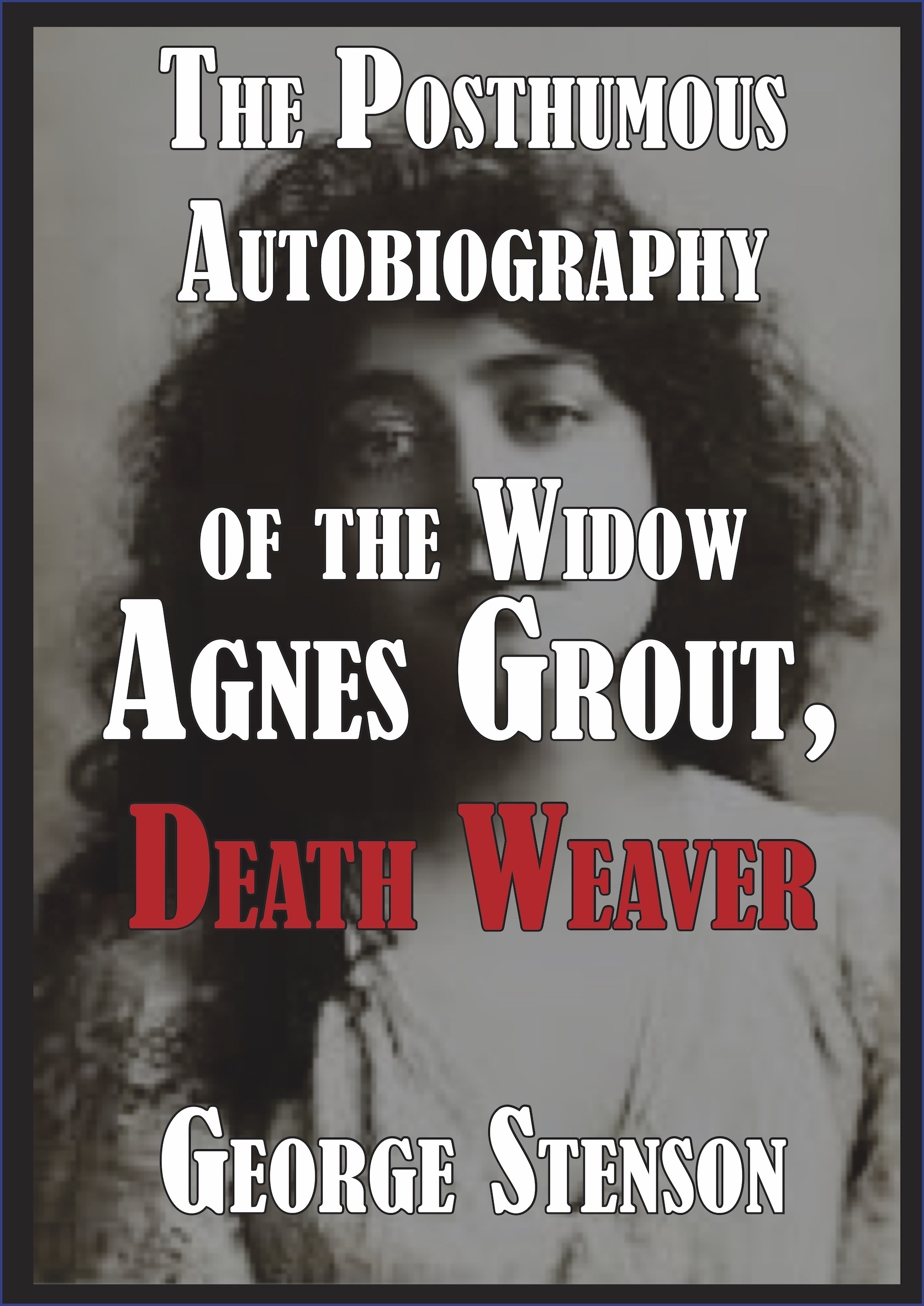 her daughter’s life. My original plan was to have her die young in an accident. I wrote the scene of her death, but it didn’t feel right. I stepped away from the book to think about it. Both of her brothers get to live to be about 100 years old, so why does she have to die young? Because, as is mentioned in the novel, she’s touched? (Meaning, she has a mental problem that is never diagnosed in the book but is probably some form of autism.) So I rewrote the premonition Agnes has about her daughter’s death and substituted someone else. I believe it works out better, and we can expect to see some changes in the daughter.
I’ve also tinkered with chapter titles. I’m leaning toward including the year. For example, now it has a chapter title like The Youngest Ever. I might change the chapter title to: The Youngest Ever 1820. I think this might make it easier for the reader to understand what’s going on and where in Agnes’ life she and her family are. What do you think?
Earth Book (mentioned earlier) was created following Snowbank Book, where I made a small, cheap, disposable book out of scrap paper and tossed it in a snow bank for 48 hours to see what would happen to small, cheap, disposable books. Earth Book is more substantial. Five signatures of five folios, cased in with proper bookboards and plain white endpapers. Its destiny? To be buried in the earth for 20 days (March 10 to March 30).
Earth Book is the subject of TDGB 45: Earth Book Pt One. Basically, it is me making the book and then burying it in the garden. Part Two will appear when I ressurect it, pull it from the earth, expose it to the elements on March 30th. You want to stay tuned for that, I’m sure.
Saturday Mar 01, 2025
Saturday Mar 01, 2025
Bookbinding
Two things happened last week. First, a family member fell sick.  Second, I fell under the spell of norovirus, the stomach bug. Third, the family member physically fell and needed to be taken to the hospital; in the middle of the night. All of us are resting well.
Needless to say, making a book was not my top priority.
But, having said that, to relax, I made a small B7 not-blank notebook with five signatures of four folios each. Not-blank because the paper was leftover school handouts with writing on one side. It was coptic- bound with a paper mailer that is used to send documents through the Japan Postal System: thick enough. More about this book in the Video section.
Other than being ill (no fever but also no appetite), I was in no mood to get out of bed or deal with the joys and intricacies of bookbinding. I am now, though. Feeling much better.
Fiction
One thing a writer can do when they’re not feeling up to par is think. So I thought. About The Posthumous Autobiography of the Widow Agnes Grout, Death Weaver. I thought of ways to make it better. Ways to make it clearer to the reader what is going on. Ways to make it snappier not in a bon mot Frasier-Nyles repartee way, but snappier in a plot-and-dialog way.
Having thought of all those things, now I have to start writing, re-writing, and rearranging the novel. One person who read the first 50-some pages encouraged me to continue as they want to learn more about Agnes, her family, and what happens to them.
This is quite the encouragement; getting a reader to be so involved in an unfinished, unfamiliar story is a talent I’d like to have for all my books.
Video
I uploaded a two-minute (ish) video of me putting mull on a book. On, of all places, YouTube. Amazing, eh? With charming (?) music.
It’s called TDGB 43: Mulling the Signatures. All for your viewing pleasure.
Coming in soon! to a Youtube channel near you! is a video of the B7 not-so-blank notebook. It’s called Snowbank Book because after I made it (five signatures, coptic binding, cardboard cover — all caught on video), I put it in a snowbank to, uh, I guess, season it? Dampen its spirit? It’ll be in the snowbank for two days. When it comes out, I’ll figure out what the next step will be. Any suggestions?