
30.5K
Downloads
171
Episodes
Episodes

Thursday Mar 29, 2012
Thursday Mar 29, 2012
 Here we have accomplished a smallish - B6 sized (7.2 " by 5.3" for my American brethren) - 128-page lined notebook with free advertising. Advertising for me. It has my blog url (this one, obviously), my email (tedorigawa.bookmakers@gmail.com), my name, and my studio name: Tedorigawa Bookmakers (手取川製本). It also has small pictures of books I have made (and are for sale), one picture of myself, and the red Tedorigawa logo - on the right. The other thing it has is an inset on the lower right front cover.
Many years ago I read that a bookbinding teacher insisted that the front of the book be obvious to the casual observer. I try to do
Here we have accomplished a smallish - B6 sized (7.2 " by 5.3" for my American brethren) - 128-page lined notebook with free advertising. Advertising for me. It has my blog url (this one, obviously), my email (tedorigawa.bookmakers@gmail.com), my name, and my studio name: Tedorigawa Bookmakers (手取川製本). It also has small pictures of books I have made (and are for sale), one picture of myself, and the red Tedorigawa logo - on the right. The other thing it has is an inset on the lower right front cover.
Many years ago I read that a bookbinding teacher insisted that the front of the book be obvious to the casual observer. I try to do that but this inset is my first attempt at really showing the front. I felt it was necessary because the back cover is more decorative than the front. I carved out a bit of the book board (next time: two thinner boards glued together; it'll be much easier) and printed 手取川製本 on a piece of paper. Then I glued it to a scrap of book board, and glued the entire ensemble into the hole in the cover. It's... okay. Next time, I don't think I'll glue it on a scrap of book board but directly onto the second book board.
 Getting the cover cloth was an interesting story. I went to a shop that is famous for its paper. People come from hundreds of kilometers around just to look and buy some of their products. I bought some paper and then asked if they had book cloth (布, nuno in Japanese). The female clerk (and part owner) didn't know what I was talking about so she asked the male clerk (and part owner) who handed me a big wad of thick paper. "This?" he said. "Not exactly," I mumbled. And he proceeded to hand me another big stack. "Take it. It's free." So I took it.
Thursday Mar 15, 2012
Thursday Mar 15, 2012
 The Priests of Hiroshima: An Historical Love Story is my novel about time travel between an Istanbul antique bookstore today and Mainz, Germany when Gutenberg was in full operation. Istanbul and Mainz, Germany. What do they have to do with Hiroshima?
The Priests of Hiroshima is the name of a novel in the novel The Priests of Hiroshima. In my novel it is a novel printed and signed by Gutenberg. How did the author in 1453 know about the bombing of Hiroshima in 1945? You gotta read The Priests of Hiroshima.
Back in 1945 when Little Boy was dropped on Hiroshima, some priests were in their church. The blast blew most everything away except for some of the strengthened walls of the church. One priest (Father Hubert Schiffer), after the bombing, was bathed from head to foot to clean his wounds. The walls protected him feeling the brunt of the blast while the bathing cleansed him of any radiation. Or it was a miracle. Fr. Schiffer was from Germany, perhaps Mainz?
 My The Priests of Hiroshima is about 112 pages, casebound, with Japanese paper as the cover. The design is reminiscent of old-fashioned farmer women's clothes known as mompei. There are seven signatures of four sheets. There is, in Japanese tradition, a strip of washi on the front cover. The title is supposed to be written vertically on this strip of paper but I haven't the calligraphical chops to do it right. It has yellow craft paper as endpapers.
Monday Mar 05, 2012
Monday Mar 05, 2012
 About six years ago a child of mine ran a 5 K race and for finishing within the allotted time, got a t-shirt. She wore this shirt off and on for six years and finally decided to throw it my way. I backed it with thin paper and turned it into book cloth. Then I waited for a project that required such a cloth. And behold, this year, the same child actually asked me to make a diary/calendar/journal for her.
I pounced on the opportunity. The result is a B6 size, case-bound book. It has six signatures of four sheets each for about 96 pages - some blank but most covered in either a monthly schedule or a weekly schedule. Also included in the book: pictures of my daughter's current favorite singer (Selena Gomez) and my daughter. Making this diary/calendar truly one of a kind.
Of course it took me forever to get right. I mapped out the calendar in Excel and did imposition via experimentation. Lots of printing until I finally got the right imposition and alignment for all. Lots of double, triple, and gazillion-ple checking to make sure the days and dates lined up correctly and so far my grateful child has only found two mistakes - not related to dates and days but content within the days. i.e. I missed writing a holiday although I had the day red-ed out as such.
About six years ago a child of mine ran a 5 K race and for finishing within the allotted time, got a t-shirt. She wore this shirt off and on for six years and finally decided to throw it my way. I backed it with thin paper and turned it into book cloth. Then I waited for a project that required such a cloth. And behold, this year, the same child actually asked me to make a diary/calendar/journal for her.
I pounced on the opportunity. The result is a B6 size, case-bound book. It has six signatures of four sheets each for about 96 pages - some blank but most covered in either a monthly schedule or a weekly schedule. Also included in the book: pictures of my daughter's current favorite singer (Selena Gomez) and my daughter. Making this diary/calendar truly one of a kind.
Of course it took me forever to get right. I mapped out the calendar in Excel and did imposition via experimentation. Lots of printing until I finally got the right imposition and alignment for all. Lots of double, triple, and gazillion-ple checking to make sure the days and dates lined up correctly and so far my grateful child has only found two mistakes - not related to dates and days but content within the days. i.e. I missed writing a holiday although I had the day red-ed out as such.
 I promised my daughter that she would get her book before the end of February. Thank god it was a leap year this year. I needed that extra 24 hours. I believe the writing on the back says Running Person in Japanese, which makes sense as most marathon runners are people. One other thing: On the front of the book it says "Kanazawa Marathon 2006." Hmmm. A schedule book for 2012 that says 2006. Odd, eh?
Tuesday Feb 28, 2012
Tuesday Feb 28, 2012
 A friend is writing an online novel called Teach Yourself Japanese: The Eddie Trombone Case. Or it might be completely true. True or false, fact or fiction, I was looking for content to practice imposition, binding, casing in, and the other particulars of bookbinding. Viola, a marriage made online.
I copied his online scribblings, did a little desktop publishing magic, imposed it, printed it out (which took close to a half-century to finish - Gutenberg had it easy), and did a link stitch before casing it in with a sort of ersatz Chinese motif cover.
A friend is writing an online novel called Teach Yourself Japanese: The Eddie Trombone Case. Or it might be completely true. True or false, fact or fiction, I was looking for content to practice imposition, binding, casing in, and the other particulars of bookbinding. Viola, a marriage made online.
I copied his online scribblings, did a little desktop publishing magic, imposed it, printed it out (which took close to a half-century to finish - Gutenberg had it easy), and did a link stitch before casing it in with a sort of ersatz Chinese motif cover.
• About the Book Part One There are six signatures of four sheets each for 96 pages. It is B6 in size and I really messed up the first time I cased it in. I forgot to push the text block up tight against the spine and it came out loose and messy. After I tossed it across the studio and shoved it in the recycle bin, I relaxed. Then I tore it apart and re-bound it. It came out better when I was relaxed.
• About "the Book" Part Two What, you might ask, is the story about? An American in Japan by the name of Eddie Trombone is missing. A consulate officer at the Osaka consulate, Gerard K. Dirkins, is charged with finding him. His efforts lead him to a book Eddie took out of the Chicago library called "Teach Yourself Japanese" and a diary kept by Mr. Trombone. From Eddie's diary, we follow his life from Chicago to Osaka and witness the many frustrations as Dirkins tries to understand Eddie's frustrating "new" and exciting (?) life in Japan. Will he ever find Eddie? Is Eddie still alive? More importantly, will "Teach Yourself Japanese" ever be returned to the Chicago public library? This book, which I have made in an edition of three (two to the author, one for me), is titled "Teach Yourself Japanese: the Eddie Trombone Case, Part 1" because the online novel is not, as far as I know, finished yet. Plus, I am currently working on "Teach Yourself Japanese: the Eddie Trombone Case, Part 2."
Second, you might ask, is why is the green part of the book so big? Well, when I tossed it across the room? I kind of ripped part of the cover which was mostly the fake Chinese red part. And, I, uh, kind of had to cover up the tears. Maybe this will be the copy I keep for myself. In retrospect, rather than a hard cover, I think I should have made it a softcover because it is only 96 pages. Kind of thin, but when Part 2 comes out, I might try a dos a dos.
This book, which I have made in an edition of three (two to the author, one for me), is titled "Teach Yourself Japanese: the Eddie Trombone Case, Part 1" because the online novel is not, as far as I know, finished yet. Plus, I am currently working on "Teach Yourself Japanese: the Eddie Trombone Case, Part 2."
Second, you might ask, is why is the green part of the book so big? Well, when I tossed it across the room? I kind of ripped part of the cover which was mostly the fake Chinese red part. And, I, uh, kind of had to cover up the tears. Maybe this will be the copy I keep for myself. In retrospect, rather than a hard cover, I think I should have made it a softcover because it is only 96 pages. Kind of thin, but when Part 2 comes out, I might try a dos a dos.Tuesday Oct 04, 2011
Tuesday Oct 04, 2011
According to my logs, I have made 100 books. Admittedly, most of them are less than stellar performances. I mean, I stapled my first book after the duct tape didn't work out. Some of these books have been ripped apart and re-built. Some of them have been put on a back shelf near the gates of Hell.
 But all of them were part of my aspiration at getting better at making these little rascals. My 100th book was a Japanese-style bound book of quotes about The Future - "The Future Belongs to the People who Prepare for It ~ African Proverb" - with nifty Japanese paper. (Picture's upside down, duh). Before that, I made a couple of casebound books which are much better than even I expected them to be.
Also according to my Book Book (the first book I made, with a cardboard cover and very badly made Japanese stab binding, where I keep a record of the books I've made so I can enter posts on my blog), I've been aspiring to improve my bookbinding skills since January, 2007. Four+ years. A very good four years of learning, thinking, improving, and progressing, I think, nicely. In another couple of decades I might even be confident. Especially when it comes to gluing in the endpapers. Slam, shut the cover and hope its aligned properly.
I'm looking forward to improving. I hope I do. I'm looking forward to being able to create a book that will be around for a century. Wouldn't that be great? To know something you've made will be around much longer than you?
Thanks for listening & reading this blog. See you next time.
Monday Sep 19, 2011
Monday Sep 19, 2011
I attended two workshops this last week (Sept. 15 ~ 17). One was for a couple of hours on two consecutive days and one was for a couple of hours on alternate days. I found I could fit both into my schedule and rushed off to Tokyo.
Yamazaki Yo's workshop - (one of his books on bookbinding) Thursday-Friday, one casebound book.
 I practiced making a 172-page casebound book (the novel This Is Life by Seth Harwood; Episode 49.) On day one, I used the link-stitch to sew it up, glued the spine, added endpapers, headbands, and that extra piece of paper on the spine, and mull. Yamazaki Yo, the teacher, showed me a simple and convenient way to measure things:
• Use a strip of paper rather than a ruler.
And to add endpapers, he uses an endpaper that is too large and then cuts the excess away rather than measure exactly and hope it is glued on straight. This made for quick and stress-free endpaper adding.I also learned how to say "mull" in Japanese: 寒冷紗 (kan-rei-sha.) Literally, 'cold-cold-gauze'. As an extra attraction, I taught the teacher (Yo Yamazaki) how to say 寒冷紗 in English. We also traded vocabulary for "clamshell box" which, in Japanese, is 夫婦箱 (me-oto-bako). Literally, 'Husband (夫) - wife (婦) box (箱)'
On day two, I made the cover using templates rather than measure everything. For the 7 mm space between the cover and the spine, I slipped in a 7-mm wide piece of wood (called a 'template' by some). For the 15 mm extra book cloth around the edges of the book board, Yamazaki-sensei had a 15-mm strip of wood. Quick, easy, and consistent. Very nice.
Marumizu Gumi workshop - Thursday-Saturday, one casebound book & book cloth.
 I took this workshop once before and you can see more on Episode 34. On Thursday night we made bookcloth out of a used t-shirt and other cloth I wanted to use.
Backing paper was thoroughly moistened, the cloth was made wet; glue was added to the backing paper and then attached to the back of the cloth. The edge of the cloth was glued down and viola, finished. Except for waiting at least 24-hours to dry. I made four bookcloths and used one in the next class.
On Saturday morning, I made a casebound book which I had previously link-stitched together (after Yamazaki-sensei's workshop). Inoue-sensei, the teacher, showed me a different way to add the strip on the spine by folding a thin piece of paper in thirds. Very nice, too. She also showed me how to make the spine flat so that it fit better into the cover - by using a bonefolder.
The benefit of workshops (at least for me at least this time) was connecting with other bookbinders, renewing my enthusiasm for bookbinding, and learning tricks that make the whole process faster, more accurate (templates) and cheaper (making my own bookcloth).
Wednesday Jul 27, 2011
Wednesday Jul 27, 2011
Welcome to Fuzzy Julius. This is a B4-size (5 1/4 x 7 1/2 inches) lined notebook with 128 pages (Eight signatures of four sheets each) with yellow endpapers. What it basically is is more practice. I practiced a better technique of attaching the endpapers and also a better way to crease the spine. It also uses pieces of paper that I wanted to use up before I ran off and purchased a few quarter acres of more paper. I have a bunch that I hope to use up with excellent books of a variety of types. I also have wood for covers that I want to use soon, too. Ta da. Look! A road paved with good intentions! Haven't seen many of those in the last few decades.


Tuesday Mar 22, 2011
Tuesday Mar 22, 2011
 This evening I finished a case-bound 128-page lined notebook with photos of the city and friends for a co-worker who is retiring as of tomorrow. There are eight signatures of four sheets each. The book is A5 (small - 8.3 x 5.8 in) in size so it will fit easily into a coat pocket. It has Japanese wave-y paper for the cover, black paper for the spine, and photos of a retirement party as endpapers. There is also a moleskine-esque strap to keep it closed.
What I learned from this book is Think! The strap could have been placed more correctly had I given it more thought. Also, when you print out about 128 pages of lined paper - buy ink. The lines sort of fade off toward the end of the book. However! It's the thought that counts, isn't it?
I shall present this book to my co-worker as a work of love for all the support, assistance, and knowledge she has foisted upon me (and others) over the years. She will be sorely missed. It is interesting to note that her selflessness has earned her high praise from co-workers but paranoia from management, who feared that she, by helping others and being a leader, wanted their jobs. Is this true of all managers or only merely incompetent ones?
Wednesday Mar 09, 2011
Wednesday Mar 09, 2011

No, no, this book doesn't run, at least not very far, but it's a notebook for writing down your running accomplishments. Well, not exactly your running feats but a friend of mine can.
I made it for a friend who runs both half-marathons and marathons. She runs nearly everyday and she runs with an iPod Touch. She probably already has an app for recording her running and exercises. (rubiTrack perhaps?) But I made this book for her anyway.
It has ten signatures of four sheets each for a total of 160 pages. It is B6 in size, which is a handy size to slip into a pocket; if you have a pocket in your running outfit. It also has pictures on random pages of marathon runners, masses of people at the start of a marathon, and a

sign that says "No Running." Why? Because my friend's motto is No Running/No Life. It was easy to find a sign that said "No Running" - every swimming pool has one - but nearly impossible to find one that said "No Life."
Also, each page has space to write down the distance run, the marathon name, the time it took to run the marathon, and comments. With each page having space for about 15 marathons, my friend will have to run about 3,000 marathons to fill up the book. No problem, eh?
The cover paper is the same as the Setsubun book down there in Episode 62. I like the feel of the paper as well as the design. It is a little rough - not really rough - so it is a tactile. I have found I work better (faster?) when I have a goal. I must be goal-oriented because once I decided to make this book, I worked on it until it was finished. On the other hand, I have four text blocks that have been sewed, the mull has been sewed on and the four semi-books are sitting on my desk waiting to be dressed. I suppose I need a good idea of what to do with them. One or two of the text blocks are lined notebooks, one is blank, and one is a novel. I think I need inspiration for the cover. Or book boards.
And an update: Last night I had a flash of insight.
I will make one of the books for a colleague who is retiring and, I'm sure, needs a handmade, lined notebook.
Monday Feb 07, 2011
Monday Feb 07, 2011
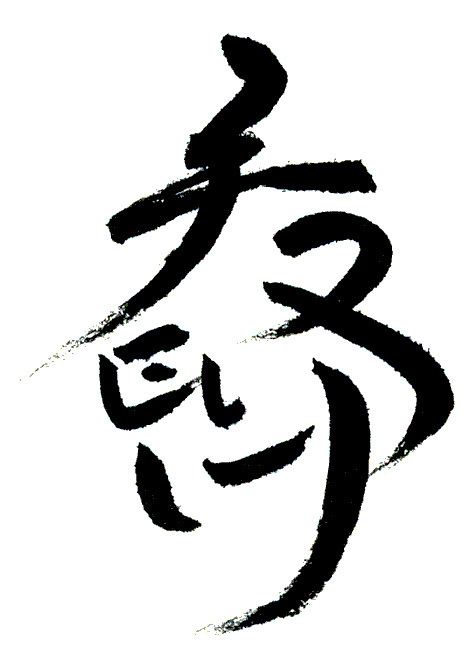 I asked a friend who happens to be a graphic artist to make
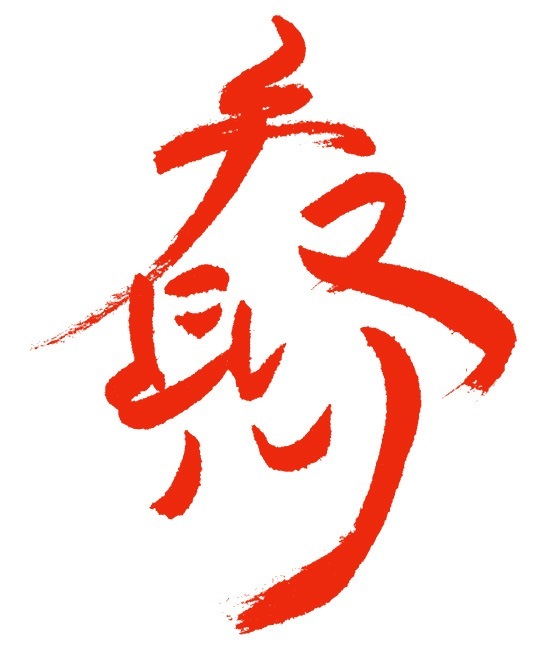 me a logo for this blog and she did. Here it is in black and here it is in red. It's got the word Tedorigawa in Japanese. In Japanese it's 手取川. The te is 手, which is on the top; the dori is 取, which is the face; and the gawa is 川 which is the smile and cheeks. Cool, eh?
In thanks, I made her this book with her name on the front. It's a blank notebook with about 160 pages in a case bound book. The covers are made of black, wrinkly paper that is kind of thick, green book cloth, and the yellow and red papers that are under the artist's name. It is also the first book to have the logo in it. An historic first! This is actually the second book I've given her. The first one was another blank book with her picture on the inside front cover.

