
30.5K
Downloads
171
Episodes
Episodes

Saturday May 23, 2026
Saturday May 23, 2026
Bookbinding 
In bookbinding this week we have, for your visual pleasure, a book One Year in the making.
Solaris Libri. This is, I’m assuming, Latin for Solar Book. (If Google translate is accurate with dead languages.)
It is an A6 blank notebook of five signatures of five folios each for a total of 100 pages. The only printing in the entire book is the title pages: Solaris Libri and under that Exposed April 1, 2025; Re-covered April 30, 2026. It has a built-in bookmark that is a silvery yellow as is the cover, of course, to reflect its connection to the sun.

I made it and then taped book board bits to the front and back covers. Then I taped it to my studio window for a year allowing the sun to do its job of fading the uncovered book cloth while keeping the book cloth under the book board bits their original color.
After a year of staring at the sun, I was surprised how little it changed. The band of original book cloth yellow on the back didn’t look too bad. It changed, but not by that much.
Fiction

I’ve been working on two novels. One is quick and short. One is longer and more involved. The first one is The Madrid Marital Murder Mystery. It’s a detective story of a married couple investigating murders in Spain. So far. They might move soon. He’s an American, she’s Spanish.
The second one is Dmitry the Scavenger about a man who finds things when no one is looking and sells them to whoever wants them. His dream is to move to Sicily where it’s warmer and more

relaxing than Moscow.
If you listen to the Tedorigawa Podcast you can hear the first chapter of The Madrid Marital Murder Mystery.
And, yes, I’m still experimenting with cover designs for both books.
Talkies / Flicks / Videos
 We have no new flicks to push today, but a brand new one is in the editing stage but it’s just not ready yet.
You can, of course, check out dozens or more of my other videos at Tedorigawa Bookmakers.
Books

Rie, the 36-year-old electrical engineer, and Nagi, the about 80-yer-old retired high school kokugo teacher, randomly met in January and develop their friendship over the course of a year.
Other people involved are Harumi, Rie’s free-spirited co-worker who wants to marry someone and can materialize wherever she wants anytime she wants.
Tadao is also Nagi’s former student and dated Rie. He’s a manga artist who owns a bar where he does his drawing and writing. His mother, Junko, owns the bar where Rie and Nagi often meet. His manga is about the strangers he meets at his bar.
Available at:
 Apple
Apple  Barnes & Noble
  Kobo
Kobo
Tuesday Apr 14, 2026
Tuesday Apr 14, 2026
Bookbinding
Aside from finishing a novella (see Fiction, right below), I printed it out to make a physical copy. It’s B6, 125 pages, and includes the Japanese holiday for each month (except June and December which have no holidays) plus other words (also in Japanese).
I made a cover for the first page, sewed the text block together, and made a ten-minute tutorial (see Talkies, below).
Fiction
I finished writing The Lonely Izakaya Down a Quiet Street and put it online. It’s about 125 pages in B6 format.
Each chapter has two parts. Part One is with Nagi, the old, retired, divorced Japanese teacher thinking about life, and stops when he runs into Rin, his former student.
Part Two is Rin thinking about her life, and continues after she meets up with Nagi.
There are 12 chapters, one for each month of the year. For more about the book, see Books, below.
Talkies
A video tutorial for sewing before casing in. At YouTube TDGB 81: Sewing. About ten minutes.
Books
My novella, The Lonely Izakaya Down a Quiet Street, is available on Apple Books and other online sites. A fifteen-page chapter is free for your reading pleasure.
Rin Okabe, a 36-year-old single electrical engineer working for an architectural office, runs into her old (really, he's almost 80), divorced, Japanese high school teacher, Nagi Shimeki. They meet at random places that neither plan until finally they agree to meet. At first, they are cautious as to why they keep meeting, but gradually learn to enjoy each other’s company.
Other characters include the flirtatious Harumi, the mangaka Tadao, the bar owner Junko, the supervisor Horiguchi, and the unnamed bucho. There’s a touch of magical realism, but mostly life in Kawasaki is grounded in loneliness and separation.

Friday Feb 13, 2026
Friday Feb 13, 2026
Bookbinding
 You’re going to get a quick and easy Japanese lesson unless you already speak and read Japanese in which case this might be boring? Rhinoceros in Japanese is Sai with the accompanying kanji being 犀. The English river in Japanese transforms to Kawa with its kanji being three vertical lines; one is not straight: 川. Together they form one of the two major rivers that flow through Kanazawa: the Saigawa (犀川) – the K morphs into G in dual kanji. The other river is the Asanogawa which means shallow river, and it is. Shallow. The Saigawa could be called the Rhino River.
My Rhino River is a 120-page, A6-size, collage covered blank notebook. I’m  attempting to push my personal bookbinding skill envelope out a bit. This is why titles appear on spines and collages appear as book covers. With my Rhino River the collage has rhinoceroses front and back. A solid rhino on the front and an outline on the back. People populate the interior of the rhino on the back and tower over the rhino on the front cover. There is also a cow, harvesters ala van Gogh, a guitar museum, and a vague Shakespeare photo.
Fiction
Work is going slow on the two works in progress I have stacked up on my To Write List: Zuihitsu and Caraculiambro. The former is moving slowly but steadily onward. It has two or three separate stories that may collide at one point. Shortly after the collision, Zuihitsu might come to a satisfying closure.
Caraculiambro is dragging. I need to re-read it to understand exactly what is going on but reading is wearing me down. Just imagine: the writer is confused about what he has written; someone’s brain needs refreshing.
Moving Pictures
TDGB 74 Rhino River is up for your visual pleasure as is TDGB 73 Making a Collage to see how I stumble through my collage making; you might learn something. Fingers crossed.
Feel free to subscribe to both my YouTube channel and this podcast; it would be greatly appreciated.
Friday Jan 09, 2026
Friday Jan 09, 2026
Bookbinding
 Yes, I finished Growing Slurry: A Whale of a Love Story. The title is on the spine and there’s a whale on the cover (front, spine, and back). The book is 265 A6-size pages, 17 signatures, with endbands, and a bluish book cloth for a cover.
It took me a while to get the title printed on the spine and then to align the spine part of the book cover on the book boards. Properly. Fortunately, I managed. Practice, I’m told, leads to success.
It takes place over the course of about 12 hours but each character (Sliven, the male; Gina, the female) has flashbacks to the past where their past lives are shown, examined, and explained.

Throughout the novel, both characters discuss Moby-Dick. In fact, they meet because Sliven is carrying a copy of Moby-Dick; when Gina sees it, she makes the first move, she ignores everything else about Sliven and they strike up a conversation, discussion, romance? – relationship. This relationship deepens with each flashback and what they discover about each other.
Fiction
I’ve started a journal/novel called The Zuihitsu of Mrs Collier. Zuihitsu is a Japanese word that literally means writing from the brush. It is a journal that can include anything the writer wishes to include. The original zuihitsu was The Pillow Book (Makura no Shoshi) by Sei Shonagon who wrote in about the year 1000. She wrote about Heian era court life, the food she ate, the people she met, and lists of things she thought important.
The Zuihitsu of Mrs Collier is similar. There is a bread recipe, observations and comments on recent events, and two fictional stories. When the two stories end, the book ends.
Video
For your view pleasure there are two videos up about Growing Slurry. One is longer and about the construction of the book and the plot. TDGB 68. The other one is the first two sentences of Growing Slurry. TDGB 67. Enjoy.
Friday May 04, 2018
Friday May 04, 2018
I have set up three books on the computer using InDesign and have printed out two. One more to print and then I have to finish writing another novel titled Feeding Vicki's Corpse. What are the three books I set-up and why do it again?
I set them up again because I have been reading about interior book design: leading, font sizes, margin widths, and content for the headers and footers (mostly the book title, the author's name, and pages). In each article I read I see something that could improve my own books, so I edit what I have to, I hope, improve them.
At the same time, I edit the content. I fix spelling & grammar mistakes, correct mis-used words (their there they're) and improve (again, I hope) plot points, characterizations, banish lazy writing, and try to eliminate clichés.
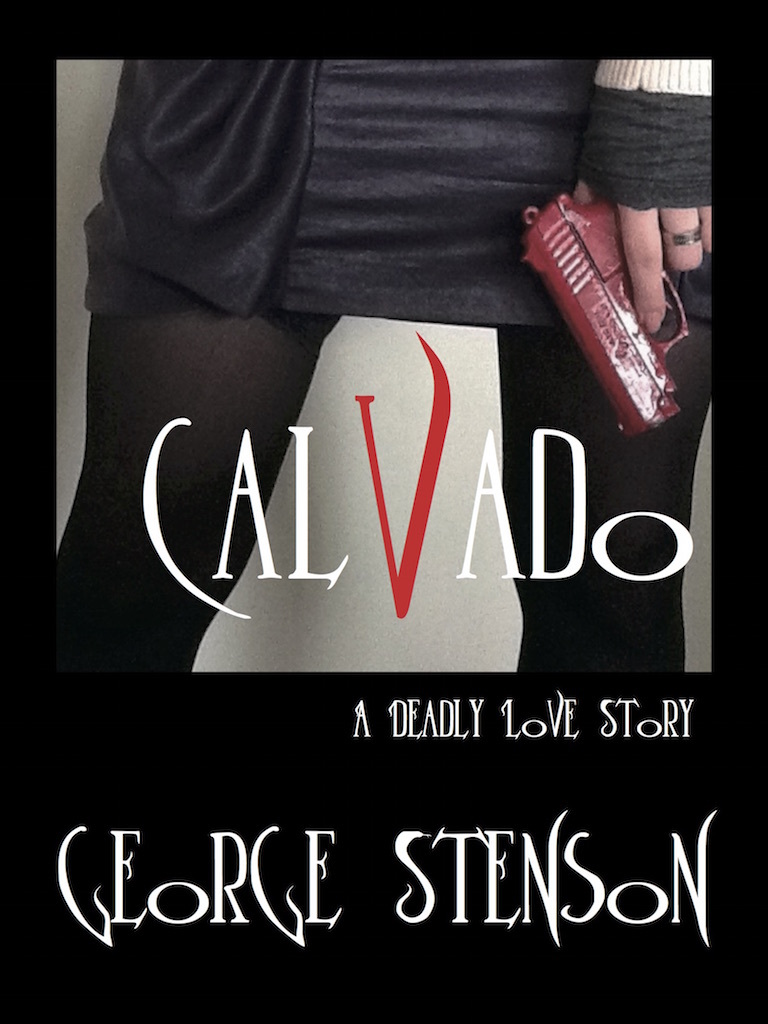 The first book is the second book in the Calvado Pentalogy — Calvado: A Deadly Love Story about a man with a deadly disease. It's deadly for the people he likes, not for himself. And he likes Calvado, once he meets and gets to know her. So, of course, he must leave her alone. He is a low-level scam artist and a struggling jazz singer. She, Calvado, the star of the Calvado Pentalogy, is a medical school student and a fashion model. Drug dealers and crazy people are involved.
 The second book is the third book in the Calvado Pentalogy — The Priests of Hiroshima: An Historical Love Story. In this story, Calvado is in Istanbul and discovers a unique antiquarian bookstore that deals only in books more than four or five hundred years old. She also discovers a cat with a mysterious power and portals to another time; a time when the modern book was being born and a forbidden love between a priest and a nun.
 The third book I set-up is the fifth book in the Calvado Pentalogy — The Venetian Slime Woman: A Biological Love Story. An EPA water quality specialist falls in love with a biological freak, so to speak. The woman is from a small island off the coast of Venice but she is born from slime mold. The CIA — or is it the FBI or Homeland Security or just a rogue agent? — wants to capture her and experiment on her body.
My next assignment from myself is to produce e-books of the Calvado Pentalogy and sell them on either Smashwords and/or Amazon and/or iBooks. Or all three. Any suggestions?
Thursday Jul 28, 2016
Thursday Jul 28, 2016
- Putting Tristram Shandy by Laurence Sterne on computer, in InDesign & iBooks Author readying them (Nine Volumes) for release in iBooks and other epub related venues
- Putting my Calvado Pentology on the same computer programs for the same venues
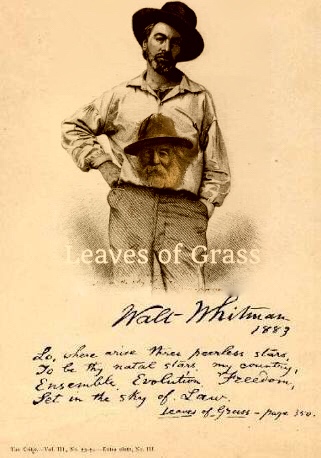
- Putting Leaves of Grass by Walt Whitman on the same for the same.
Friday May 30, 2014
Friday May 30, 2014
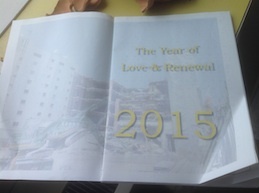
 Usually I manage to panic and start making next year's schedule book in late October or mid-November. Obviously this is not the best of times. So this year I took the matter into my own hands and made a schedule book in May, a full seven months before it is actually needed.
 The day after I printed out a prototype and sewed it together, the Japanese government added a new holiday. Back I ran to InDesign to make that a red-letter day. Not the government's decision but the actual day itself which, if you'd like to know is August 11. It's called Mountain Day, the fourth in a series of national holidays that celebrate nature. The other three are Sea Day (in July), the Spring equinox (in March) and the Fall equinox (in September). Mountain Day makes the 16th national holiday thus far in Japan.
My 2015 schedule book has two yearly calendars (2015 & 2016), a monthly calendar that runs from January 2015 to March 2016 (everything ~ schools and work ~ starts in April in Japan), and a weekly calendar that runs from Jan. 2015 to the end of April 2016. And why does the monthly calendar end in March and the weekly calendar end in April? Good question. I think I have more work to do.
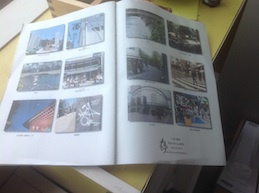
 It also has 12 pictures but the pictures have nothing to do with the seasons or the months. They are photos I took of relatively well-known scenes around town. In the book itself the pictures are muted so that the dates and days can be easily seen. Not your usual touristy shots but shots of parts of places so that people who live here can try to figure out where it is. At the end of the book are all twelve pictures with captions so people can check if they're right or not.
Monday Jan 13, 2014
Monday Jan 13, 2014
 I presented three 2014 Schedule Books as presents for Christmas 2013 but only got around to presenting them in 2014, but well before a month late. Only two weeks late. Actually, I gave four 2014 Schedule Books but one person got their book in late December! Shocking, I know.
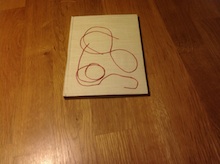
 At left is the cover of one book. It has textured off-white book cloth with a thin red string glued to the front. This one is B6 in size; slightly larger than a pocketbook but has more space for writing in the monthly & weekly calendars.
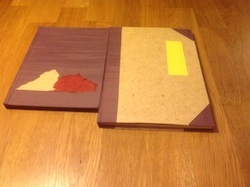 All four schedule books consisted for the same basic format with each one personalized with different pictures and certain dates. For example, each person's schedule included friends' and their own birthdays. The books were about 100 pages. Each schedule included a yearly calendar covering 2104 & 2015; and a monthly calendar followed by a weekly calendar. With photos interspersed as I saw fit.
Three books were B6 in size while one, the one with the yellow rectangle on the cover, is A5. Or, if you're a north American, three were about 5 x 7 inches and one was 6 x 8 inches. Each book had a different cover, different photos, and different endpapers but the basics were the same. The basic calendar was made in InDesign, converted to pdf, and printed out using Cheap Imposter.
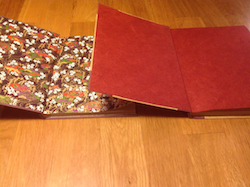 The most encouraging aspect of this project for me was the adding of the endpapers. I think I did a good job of gluing them in properly, and straight. At right you can see the Japaneseque endpaper on one of the smaller books with the very red one on the large book.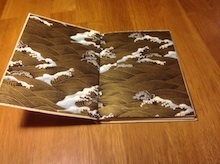
Hold Tight.

Tuesday Dec 17, 2013
Tuesday Dec 17, 2013
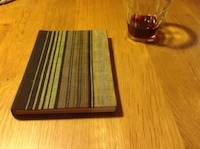 Are words and books connected might seem like a strange question but the books I'm referring to are notebooks. Specifically, the lined notebooks ~ complete with page numbers ~ that I enjoy making. Many people make blank notebooks; some people make lined notebooks; but I enjoy making lined notebooks with words in the margins. You might not be able to see the words in this notebook, but at the top on all the pages are words in Japanese and their English equivalent. Many are useful but there are also puns, homophones, and phrases.
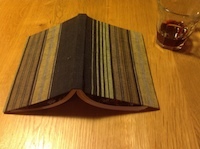
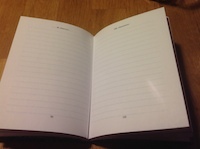 this time I splurged on an iron-on variety. I used the iron-on variety for two reasons: I don't have the space to splash a lot of water around and it's quicker. In the future, I might go back to making my own backing but as for now, I just want to use up as much cloth as I can before rushing out to buy more bookcloth. Plus, making my own book cloth helps create unique books.
Speaking of quicker, from printing the pages out on my soul-sucking Epson printer to pulling the complete book out from under the weights it slept under for a night, took about 12 hours. InDesign was a big help and if my printer didn't eat a page, and thereby screw up all the page numbers and layout for subsequent pages, it would be quicker. This particular layout is on my computer in both A6 and B5 sizes.
 The endpapers, though, are very Japanese-y and not that cheap. Not that expensive but the paper was purchased at a Japanese paper shop here in town and comes in a large sheet. Seeing as how the words are in English and Japanese, I thought this paper was a good choice. Better than a marbled paper, in any case.
At first I was going to print the name on the cover but then I decided my printer would probably have a seizure and refuse to thread it through. I didn't want to jam up my printer when I have a lot of reports to finish; if I ever get around to them. Therefore, no printing on the cover. I might make a dust cover for it. That would be a first. This book had a couple of firsts already though. The first first was the iron-on backing for the cloth. The second first was my attempt at getting it done fast. From tweaking the InDesign file to folding & sewing to gluing and making the cloth was, as I said, about 12 hours ~ including sleeping under pressure. I think I can speed things up and make more in one sitting if I were industrious enough.
Sunday Dec 01, 2013
Sunday Dec 01, 2013
 Tuna Imagination's subtitle is A Fictive Collective which means it has snippets of history, fiction, one complete short story, an array of pictures and doodles, and is in many ways a hodgepodge of miscellany.
What kind of history? Mostly related to books and printing especially about Aldus Manutius, inventor of the comma; also Xenia Cage (John's ex-wife) who was Marcel Duchamp's bookbinder, and Nicholas Jensen.
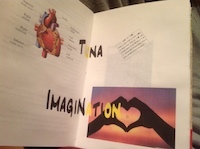 What kind of pictures and doodles? Well, of course, Xenia's photo but also a post-modern printing done by Manutius in the 1400s in which the words formed the pictures - an innovation then as well as unique 600 years later. Plus pictures gleaned from Das Google to illustrate something in the short story - an episodic short story interspersed amongst the snippets of fiction and history.
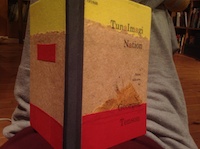 And what is the short story? It's a story about a college student who discovers the meaning of life through a punch in the nose that gives him cerebrospinal fluid rhinorrhea. i.e. his brains leak out through his nose and while he slips in and out of a coma, he envisions the snippets of fiction and history. He is, in other words, the narrative glue that holds the book together. Kind of.
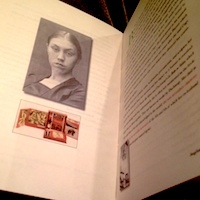 I printed the cover on bits & pieces of leftover book cloth, but first I glued the pieces onto construction paper. One reason the front and back cover colors are not perfectly aligned, especially the red, is the quantity of book cloth for all colors was different. I am attempting to use up as much book cloth as possible before splurging on more.