
29K
Downloads
182
Episodes
Creating Handmade Books and Writing Fiction in Kanazawa, Japan 金沢市
Episodes

Tuesday Nov 05, 2013
Tuesday Nov 05, 2013
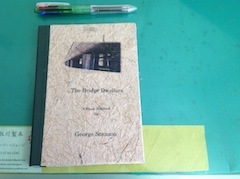 What constitutes a real book? For most of my non-bookbinding friends it is a picture and title on the cover and spine plus a headband. I made my first demi-headband the other day. A rolled piece of bookcloth around a piece of string and sewn into the signatures using a contrasting color. I like it more than the glue on kind of headband, that's for sure.
 On the other hand, I've also made two roundback books in the last couple of weeks. Both Frankenstein and Dracula were roundback and Frankenstein had my first attempt at sewing headbands. But the thing that really makes a book a Book in the minds of mere muggles is the cover design. Do I really want to start learning how to design a book cover well? That's definitely a rabbit hole one can fall down.
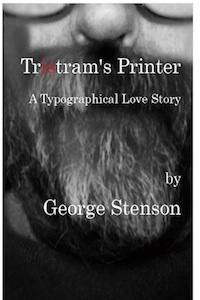
 That said, here are two covers of two of my novels that I have designed. One, Tristram's Printer: A Typographical Love Story, is available from Smashwords.com. It's about art, love, bookbinding, and artists. Calvado: A Deadly Love Story, is being edited for clarity and consistency. It's about love and murder.
But I think the covers, the headbands, the roundback all contribute to a good-looking book that would be easier to sell than even a coptic binding, even if the coptic binding were excellent. The fact that it
 doesn't 'look' like a book. I, of course, would have to show the buyers the advantages of a coptic binding vs a perfect binding.
Sunday Jun 30, 2013
Sunday Jun 30, 2013
 I don't know what it is but whenever I travel, be it by train or car, I find the need to sew a book. Train travel is the best as I have the comfort of not having to watch where I'm going but I still get to my destination relatively unscathed.
Last weekend, I spent two days in a small town out of my normal town. On Friday, I printed out two books and on Saturday, after I circumnavigated the small town afoot, I sewed one. On Sunday, when I was recuperating from a two-hour hike around a forested hilly peninsula, I sewed the other one.
Both are B6 (nicely pocket-size) ~ B5 folded in half ~ lined notebooks with page numbers and small Japanese-English translations (製本 (seihon) ~ bookbinding) on the upper outside corners of each page. I used my usual link stitch to sew them together and used black thread on one and white on the other. Each book is about 192 pages ~ 12 signatures of four sheets each.
 Now, I have many, many naked books that need covers. Well, at least six or seven. I'm aiming at experimenting with design printed on book cloth for most of these. Titles on the cover seem to make the book more.... real? Titles on the spine might even make them more saleable? One can only hope.
Wednesday May 22, 2013
Wednesday May 22, 2013
 My most recent event was the making of two A6-sized lined journals with a slight difference. The difference is that each page had a translation in Japanese and English of a bunch of random words. The words came in two or three categories. First, such words as most learners of English will come across in their studies such as 'food' and 'study'. Second, confusing words the learner of English will probably see sooner or later such as 'book' which means both 'something people used to read in the 21st century' and 'make a reservation.' Third, fun words such as 'bamboozle' and 'booze.'
 There are eleven signatures of four sheets each which translates into about 176 pages (both sides, of course. I've decided to count pages like normal people do.) They are A6 in size (41/4" by about 6" for my American friends). The procedure was as follows:
First, think of the words, write them down, and get them translated. As much as possible, I tried to pair words together that reflected something that both words shared: pronunciation in either Japanese or English, meaning, or rhymes. For example, "I" in English is a homophone for "eye". And 愛 (pronounced 'I') means 'love' in Japanese. So 'I,' ' 愛,' 'eye,' and 目 (pronounced 'may') are clustered together. 目 means 'eye' in Japanese
 Second, put everything: lines, words, logo on a new file in InDesign and spend a few seemingly hundred hours tweaking it. Third, hope your printer can print out all the pages without eating a few in the process. Fortunately for me, this time, my happy Epson printer was mostly up to the job.
After printing out two copies of the book, I folded, sewed, and glued the spine, mull, and spine reinforcing paper. I then put the two naked, lined, wordy journals on the ever-growing pile on my desk of unfinished books. This gives me five books I must case in in the next week or so.
Most of the time was spent on getting the words and translations. However, the  second most time-consuming process was printing. Being careful to print the right pages in the right order; being sure the printer didn't skip a page; making sure it had ink. Fortunately for me, I use a program called Cheap Impostor that does the imposition but between the preferences for Cheap Impostor and the Epson, sometimes I manage to print things out of order. Sometimes? Often. I'm practicing, though, so someday I hope to be as smart as my machines.
Monday Feb 18, 2013
Monday Feb 18, 2013
 This weekend I spent way too many hours making books. Not that I made a lot of books but I learned to do things I haven't done before. For example, half binding is the book cover that has the corners and spine the same material but the main part of the book cover is of another material. I made three of those.
The picture above shows the third one. It is a 200-pages, lined journal, A5 in size. (Or, for my American friends 6.25 x 8.5 inches) Half bound, as you can see. Measuring is important. I keep saying that but it really is true: the corner pieces have to be the same size, the middle spine cover has to balance on either side of the spine and, of course, the middle bit has to reach under the corner and spine pieces. All very left brain.
 Before the third book, I made one from a recycled Ritz cracker box and this book. The front is simpler but the corner bits look better, I think, because the measuring was better. It is about 100 pages, lined, and the same size as the other. The lines of both books are both light red and light blue (they change color mid-page).
I have on my work table two more books I need to bind. One is a novel and the other is a lined journal with about 400 pages. The journal will be half bound (as the binder is half-baked), while the novel will be quarter bound (just the spine cover). Both will push my personal envelope by having print on the cover. Should be interesting.
Tuesday Jan 22, 2013
Tuesday Jan 22, 2013
 This last weekend I experimented with printing on book cloth, something I have never done before. The printer is old and managed to print most of the cover I wanted to use. As you can see, it smudged on the left side and didn't complete printing the Tedorigawa logo - just the top part.
The book itself is one of many experiments and attempts at improving my bookbinding skills. It has about seven signatures of five sheets each which makes it a 140-page book. However, the pages are made up of misprints from another A5 size book I made - a schedule  book. The point of this book is the printing and the Measuring of the Spine Cover.
The spine cover is pretty well aligned and equal on both sides of the spine. The red book cloth is glued on fairly well, too. In fact, except for the printing part and the misprints on the inside, this is a fairly good book.
The good part is I am happy to try printing on book cloth again; this time with a newer, cleaner printer.
Friday Jan 11, 2013
Friday Jan 11, 2013
 This is a 128-page, A6 (41/4" x 6"), lined business card. I plan to pass these out to bricks-and-mortar stores that allow me to place my other books on their shelves. Similar to the "T" book in Episode 93, down below a few flicks of your mouse. It has my contact info on each page plus my photo at the end. What store could refuse them?
The book has left over handmade book cloth on the back cover. The original bookcloth can be seen in Episode 84, a few more mouse clicks down the pike. The front cover is made up of three items:
 1. Blue craft paper.
2. A label from a local sake (酒) named Tedorigawa - in fact this Japanese says "Tedorigawa". First, of course, I had to empty the bottle, then soak it in the sink for a few hours to get the label off.
3. A loop of very flexible metal that I found in my "To use later" pile of cr... supplies. I thought with the silver of Tedorigawa, it fit nicely. Also, it makes it harder to pile other books on top of it so that store owners will keep it on top and accessible. And visible. Mainly, though, I just thought it looked nice.
 It is also one of the few books that I cut the fore edge to make it straight when the book is closed. Usually, I don't cut it but lately I've been thinking I should. Or it depends on the book. Some people think a book with an uncut fore edge looks 'incomplete' or 'unfinished'. I think they look rough and natural but, well, you know some people, eh?
Meanwhile, the ongoing saga of re-writing and editing of Calvado: A Deadly Love Store continues. I was hoping to get it up on Smashwords (links to my Venetian Slime Woman: a Biological Love Story) by the end of January (2013) but this is looking doubtful as I found a few major plot holes. It is still a good book but I want to make it the best I can and one that you can enjoy. I work on it everyday so hopefully, you'll be able to get a copy before the end of the year (2013).
And, why are the pictures all upside down?
Thursday Dec 20, 2012
Thursday Dec 20, 2012
 My bookbinding teacher allowed me to try my hand at a round-backed book and this is my first attempt. It has 400 pages, all blank except for one which has a drop of my blood on it from where I stabbed myself with a needle. Fortunately, I only stabbed myself once as I was using five needles at the time. My first five-needle sewing and my first round backed book. Wow, two firsts in one book. It is also B6 in size, I think. And no, that is not a full-sized sake (酒) bottle, it's a smaller one, luckily.
More people feel as if the following six requirements make a 'real' book:
1. Hard cover 2. headbands 3. rounded back 4. content 5. Writing/design/picture on the cover 6. Writing on the spine forcing a right-handed head tilt.
Some people even insist on leather covers but when I ask them when was the last time they bought a leather covered book the answer is somewhere between never and never.
 Blank books, coptic binding, book covers made of paper... these don't, to some people, convey the idea of a real book. So, I'm working on including all six of the 'requirements' in my books as possible. And the more requirements I add, the more people compliment my work. Is this because I'm meeting their expectations or I'm actually getting better at bookmaking?
This book also has my first use of marbled endpapers. Not a cheap option, let me tell you, but it fit really nicely with the cover. So it has three firsts in one book. My, what an exciting time it has been.
The second re-write of Calvado: A Deadly Love Story is in progress. I hope to have it up on smashwords.com by the end of January. Calvado is the story of a model/medical student who gets involved with a singer with a mysterious disease. There is love, death, violence, mystery, humor, and medical mnemonics. It is also the first in the Calvado Pentalogy. In each book of the Calvado Pentalogy, Calvado makes an appearance, though she might not always be the center of attraction (which is something she doesn't really want to be anyway.)
Enjoy your winter vacation! See you next time.
Monday Dec 03, 2012
Monday Dec 03, 2012
 After having made my first (primero) double book, I decided to give it another shot; try again, so to speak. The first one came out good so why not, eh? This second (segundo, or in Arabic: ثان) double book is made up of misprints and mistakes from making the previous 2013 schedule books which can be seen below in Episode 90.
The Red Side is made up of ten signatures of five sheets each for 200 pages. It comes with Chinese lettering on the cover and a reddish orange bookmark. And a picture of Cai Lun - inventor of paper circa 105 AD.
The Yellow Side is made up of ten signatures as well for about 200 pages making the combined book a total of 400 pages. It also has a yellow bookmark and random pictures of Kanazawa.
 What do we take away from this exploration into bookmaking? First, making dos-a-dos was not as difficult as I first thought. Intimidation was my main stumbling block which, upon reflection, causes many a person to stumble.
Second, these types of books were often used for double novels, especially science fiction, in the past. I think they'd make for easier reading than as a blank journal. They're a bit cumbersome to write in.
All-in-all a good experience that I enjoyed having but I doubt I'll make more unless I have a novel or two to print and sell. (Hint, hint:  Tristram'sPrinter and The Venetian Slime Woman
 - both available at Smashwords.com for reasonable prices: $2.99 and $1.99, respectively.)
See you next week with two more 2013 Schedule Books!
Coming Soon to Smashwords - Calvado: A Deadly Love Story
Tuesday Nov 27, 2012
Tuesday Nov 27, 2012
 After a long train ride my confidence in sewing increased. Now, after a weekend of casing in books, my confidence in casing in has increased. Practice, as it turns out, helps. Confidence, it should be noted, is not the same as competence. I'm sure I could get better at casing in but my confidence is less a hindrance than before. I cased in four books this weekend but two were a new binding for me: the dos-a-dos. Here is the first one.
One cover has red and gold Chinese writing (meaning 'Good Fortune') and nine signatures of five sheets each for a total of 180 pages. With a black bookmark and headbands made out of the same paper as the paper used on the other cover. Both books are A6 in size (pocketbook size or 41/2" by 6+" for you Americans). It took my bookbinding teacher and I a few minutes to figure out how to apply the cover papers but we worked it out quite nicely, I think.
 The other book has Nepalese writing on it, I think. It has eleven signatures of five sheets for 220 pages. It has a red bookmark and headbands that are made of the same papers as the paper used on the other cover. My teacher's idea, by the way.
What did I learn about this experience? A few things. First, it's nice, frustrating, exciting, and rewarding to push my personal envelope. Second, gluing the top paper to the bottom paper is better than the opposite. If you glue the bottom paper first, you're not going to get the edges of top paper glued properly. Third, it would be nice to have two brains. Fourth, more time to make more books would be a real confidence builder. And maybe competence at the same time.
Speaking of competence, the interview on this episode is with my bookbinding teacher: Masayo Wakai of MameHonKobo- Wakai. Here, very roughly, is a translation of the interview. Very rough, so if you're a talented Japanese-English translator, don't judge me too harshly.
When did you first become interested in bookbinding?
About seven years ago.
What was the first book you made?
About 20 years ago I made a book about color for an art class I was taking in college.
Did you make any books between 20 years ago and seven years ago?
Nope.
How long did it take from the first book you made to the first good book you made?
About six months. I got a book about bookbinding and studied it while I made a book. I would make three books in one day.
When did you start selling your books at craft fairs?
About two years ago.
What advice do you have for people who are interested in bookbinding as a hobby?
Start making books and study what you made. If you study it you will find what is good and what is bad. Eventually, you will get better and better at making books.
Thanks for listening. Next week: The Second Dos-A-Dos book.

Friday Jun 29, 2012
Friday Jun 29, 2012
 Rather than name this book after its obvious origins (a beef curry package), I decided to go with What Is This? What Is This? is a B6 blank notebook with seven signatures of four sheets each for 112 pages. It is made of a recycled Beef Curry package. The cow the curry was made out of, according to the package, was raised by Miyazaki University students. Hence the name of the curry is MiyaDai Beef Curry. (Dai being short for daigaku - 大学 - which is Japanese for university.)
Gee, free Japanese lessons with your bookbinding enjoyment. It's always nice to learn another language, isn't it?
 Actually, the curry name shows you three of the four written syllabary Japan uses. The MiyaDai (small, in white) is kanji; then in big English letters is Beef; following that is katakana which Japan likes to use for words borrowed from other countries. The katakana here is カレー - kare, pronounced ka ray - or, in English, curry. This might be one reason Japanese students are in school studying Japanese for twelve years, eh? I mean, they study English for at least six years (junior high and high school), plus at least one in college. And advertising uses all three or four syllabaries to an artful result. Sometimes.
There's another syllabary Japan uses called hiragana but we don't need to go into that here, do we? Nyah.
 What Is This? has a red bookmark made out of a ribbon recovered from one present or another, and a yellow strap to keep the book closed during typhoon season, which is fast approaching Japan. The yellow elastic strap was 30 mm wide but I've discovered that 15 mm is a better width. I cut it in half and it slowly unravels as the book is used. This is known as Unique and Stylish. Or Planned Obsolescence. In either case, What Is This? was a quick book to make and will be fully used as a notebook by someone in the future.
What I am actually doing with these curry books is trying to perfect one or another skills. Attaching a strap or measuring the spine differently. Maybe even trying to improve my endpaper attachment technique. I haven't been working enough to improve as well as I want to so I thought more and more cheaply made books will push me up and over a plateau. Whether this is working or not isn't up to even a mild debate.